Airbnb is changing its house rules on November 20th—and some hosts NOT happy.
No more checkout chore lists and potentially MORE work for your cleaners. But here's what most hosts are missing: these changes could actually give you a competitive advantage!
We own 14 Airbnbs, from large mountain homes to a luxury condo in Turks and Caicos, and we've learned that adapting to guest expectations is key to running a successful Airbnb business.
Today, we're breaking down the nuances of exactly what's changing, what you CAN and CAN'T ask your guests to do, and how these new rules could impact your cleaning costs, guest reviews, and ultimately your cash flow. If you want to know exactly how this impacts your Airbnb investment book a free Airbnb coaching call with us!
We'll share the simple steps you need to take BEFORE November 20th to protect your business and stay ahead of the competition.
Topics covered in this blog post:
- The New Airbnb Rules Every Host MUST Know Before November 20
- The Checkout Chores Airbnb No Longer Wants Guests Doing
- How Airbnb's New Rules Could Eat Into Your Profits
- The 7 House Rules Airbnb Now Allows
- The Hidden Cleaning Costs That Could Hurt Your Cash Flow
- What You MUST Update to Stay Compliant With Airbnb's New Rules
- Why Airbnb's New Rules Could Give Smart Investors a Competitive Advantage
On November 20th, 2026, Airbnb's new house rules are going into effect. Their goal is making house rules easier for hosts to set and for guests to read and follow. Lots of hosts are jumping to conclusions and totally freaking out. Change is never easy, but we're going to take a deep dive into Airbnb's new rules so you know exactly what they are and how they impact you, your housekeepers, your guests, and your profits
Where did this initiative come from, and what's Airbnb's motivation?
Number one, Airbnb's biggest competition is hotels, and we all know you don't have to strip your bed or wash your dishes when you check out of your room at the Marriott. This is so. By removing Airbnb, by removing many of Airbnb's host rules, they are better able to compete with these hotels and so are we.
Number two, I think we can also blame the Karen hosts. You know who I mean? The ones with the insane 22-point checkout lists for their guests. As helping push the new Airbnb rules along. For example, a number of years ago, we stayed for one night at an Airbnb in North Carolina. We were on the way to visit family, and the checkout rules included washing and folding all towels before leaving.
We were leaving really early to get on the road, so I had to set my alarm for 5:30 AM to have enough time to wash and dry the towels before we left for the second part of our trip. That was ridiculous. I did it because I'm a good person and followed the rules, but it definitely took away from the Airbnb experience, and I kind of did wish we had stayed at a hotel where we could've just got up and rolled out. And that's hurting demand for Airbnbs.
Exactly What Airbnb Hosts Need to Know About New Airbnb Rules
Hosts now have seven rules they can choose from. One, pets. Yes, no, how many? Two, events. Three, smoking, vaping, e-cigarettes. Four, quiet hours. Five, maximum overnight guests. Six, commercial photography and filming. And seven, lock up at checkout. You can also allow all, some, or none of the Airbnb service categories in your home.
And I wasn't really sure what that meant (like what is a service category) so I looked it up. And this setting lets you control which Airbnb services, like chefs, photography, catering, personal training, massage, spa treatments, hair and makeup can take place in your listing.
We definitely have had guests have masseuses at our Airbnbs and chefs, but you may or may not want some of these other services in your listings. So you can choose to allow them all, restrict some of them to specific categories, or not have any of them allowed in your Airbnb.
Heads up! In November, these rules will be shown more prominently on your listing so guests know what to expect.
This helps you as a host, but is also a double-edged sword. If you have too many rules, guests might look for another Airbnb in your area that has fewer rules. On the flip side, maybe you don't want the guests that want 80 people to come over during the day and have all these services, depending on your community and your neighbors.
Hosts Can Ask Airbnb Directly for Rule Clarification
My big takeaway is instead of worrying, which I am guilty of, ask the source for clarification. If you have a very specific question about your property's house rules, you can go to airbnb.com/help and ask Airbnb's chatbot your specific question.
As a test, I asked if we could ask guests to put dishes in the sink, and it said, "Yes, that's compliant." I then asked the chatbot if we could instruct guests to put dishes in the dishwasher, it said, "You cannot ask guests to do that." Womp, womp, womp.
I love this because there's been a lot of online chatter about what these rules mean and don't mean, and different interpretations. I was really pleased to find this help bot to really get those clarifications and not just speculate or find out the hard way.
I don't think anybody's really talking about that, and if you've got questions and concerns just jump right over to that chatbot skip the facebook groups full of hearsay, because honestly, none of us need that. What you need to do as a host to be compliant.
How to Be Compliant To Airbnb's 2026 Rule Changes as a Host
Prior to November 20th, change your rules. Add requests if you need to on Airbnb platform. As far as the physical space, I've seen a few messages on different groups about having physical lists outside of Airbnb to encourage the guests to do more checkout chores.
That's gonna be a no-no. Airbnb specifically states that hosts should not write additional rules elsewhere on your listing or on signs in your home. So before November 20th, you need to change your hard copy manuals or signs, and also update your guest messaging to reflect these new rules.
Personally, we've trained Host Buddy to respond to guest questions about checkout requirements by saying, "All we ask is that you leave the cabin tidy and lock the front door." This leaves the definition of tidy up to guests.
99% of guests are good people, so they'll do more than just walk out and lock the door. And the 1%, they would have left a mess regardless of your stated rules or checklist. So err on the side of realizing that people are good people. We talked about it. We're like, "How do we have the best message?" And just leaving that definition of tidy up to guests, I think, is pretty brilliant.
And no matter what you line item in some house rule somewhere, guests may or may not be reading that. They might not be closely following it. They never do that. They're going to do what they deem right at checkout. So these changes to the rule nuance, I don't think are going to have that great of effect on Airbnb check outs.
To that point there's really no need for the industry drama that we are seeing, circulating through social media. People love the opportunity to freak out and gather more attention and followers. We're not those people. This isn't that big of a deal if you handle it appropriately.
The Impacts Airbnb's New Rules have on Hosts, Housekeepers, Guests, and our Competitive Markets
First up are hosts. As we said, we will all have to update our rules to be compliant with Airbnb's new rules on each of our listings. That's not so hard. We'll also need to monitor how this impacts the workflow and timeline of our housekeepers, and adjust accordingly So let's dive into the housekeeper component.
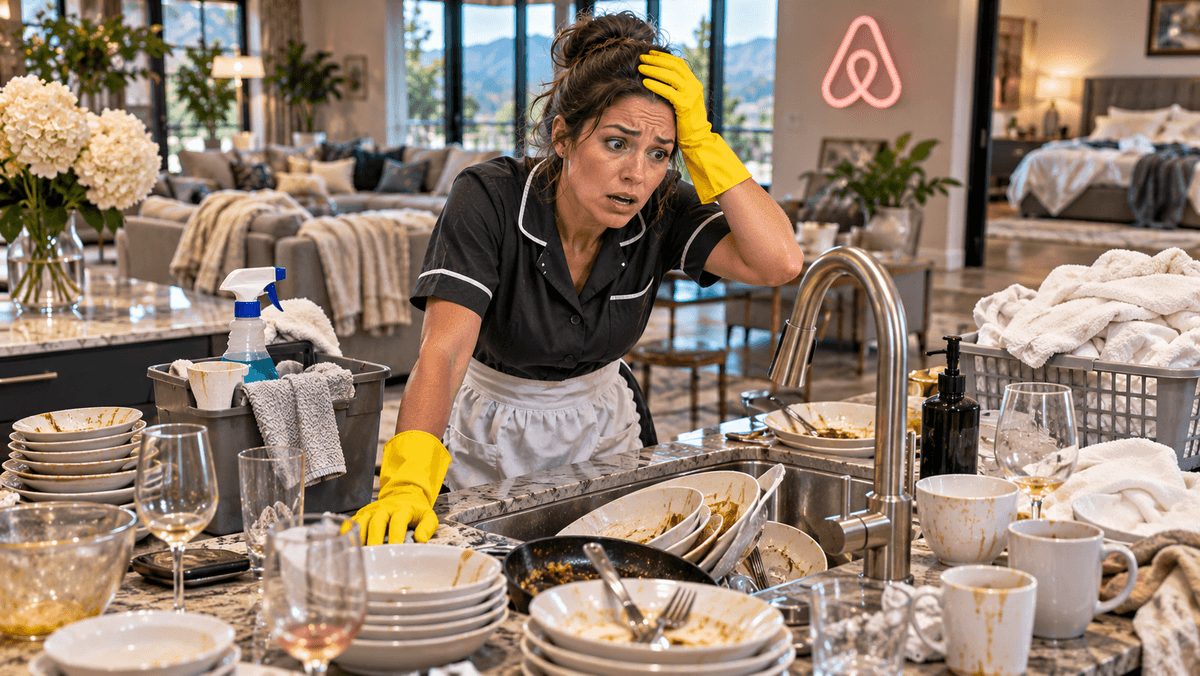
Airbnb housekeepers are probably going to have more work, particularly those that were used to guests doing a huge checklist of chores. For us, it's not so bad. Our housekeepers are used to dishes being washed and that's it. So hopefully we won't have any big issues.
I will say that years ago we used to ask guests to take their trash to a dumpster on the way out of town. We paid for access to it, but that met with a lot of pushback, some private feedback, and actually a negative review, so we stopped asking guests to do that. Again, that's the professional host mindset of adjusting to guests' expectations and responses to rules.
But if you have a large property with loads of dishes, laundry, and trash, you may to, need to make some adjustments with the new rules. Things like doing laundry off-site, adding a helper for your housekeeper, and/or giving them more time in between turnovers to make sure they can do their jobs well. This could lead to increasing what you are paying your housekeeper based on the amount of time they are spending cleaning.
For gigantic Airbnbs, if you do not have a large cleaning team, you may need to block a day in between guests to have enough time to do everything. This means a loss in revenue for each day that you cannot offer to your guests.
We're talking about preparation, but I think it's also gonna be a real wait and see kind of situation. Do your guests' behavior change? Does your housekeeper load really change, or does this kind of turn out to be not a big impact?
How the New Airbnb Rules Impact Airbnb Guests
We just gotta wait and see. I agree. As for guests, they're gonna be most likely rejoicing that they have less to do when they check out of an Airbnb. What they may not realize is that dishes and laundry are time-consuming tasks, so hosts will have to change to earlier checkout times and later check-in times to make sure that their teams have enough time in between guests.
Also, all those guests who reach out to see if they can check in early, I'm guessing that's gonna be a big, fat no now 95% of the time because every minute of a turnover will be spent making the space guest-ready. I can't tell you how many times we receive messages asking for early check-in. I don't mind. We text our housekeepers. I would say it's about 50/50. Mm-hmm. Yeah. Sometimes it's like, oh, it's done an hour early or a half-hour early, or there's a rare occasion where we had an orphan that Culin didn't fill, and so then they can check in whenever they'd like.
I do believe you're right, Culin. The people that are asking for early check-in, it's not gonna happen. There's gonna be less of that. I can also see an increase in the time spent and the work done potentially increasing cleaning fees that get passed along to the guests, which is something they won't be celebrating. Most Airbnb hosts feel like the guests are winning on this particular situation, but with higher cleaning fees, later check-in times, earlier checkout times, it's getting distributed pretty evenly across the board here.
How Airbnb's New Rules Impact the Market for Airbnb Investors
As for the market, we often say that this is the era of professional hosts. That original bring your own sheets style of hosting with dead animals and doilies in their places are not keeping up with the changes on Airbnb and the increase in guests' desires.
Things have evolved. We're expecting greater and greater hospitality over the last five to 10 years. This also takes us back to the Karen type hosts we've talked about earlier. I'm guessing the new Airbnb rules rollout is going to have them selling their Airbnbs and moving on to more lenient platforms.
Hey, that's good news for us. Less competition in our market means more guests stays at our properties. And less bad experiences in an Airbnb. If you stayed somewhere and had to get up at 5:30 in the morning to scrub the baseboards before you left, you're not gonna come back to that platform. You're gonna go back to hotels. So it could be a very positive change for the professional hosts in the Airbnb space.
As an Airbnb investor with multiple listings, this is an opportunity to stand out from the crowd further. Embrace the changing landscape by limiting the tasks we impose on guests. We say we're like the front desk manager at a boutique hotel. Picture the Ritz Carlton. How are you going to respond to guests in that role in that situation? They're not gonna have to clean the baseboards with a toothbrush, I promise.
Host Requests Under the New Airbnb House Rules
Let's move on to host requests. If you have more house rules than the seven allowed by Airbnb, take a few deep breaths, it's going to be okay.
If you have additional things you ask of your guests, they can be added as a request. These are things like asking guests to remove their shoes indoors or limiting daytime visitors. All the requests must be reasonable under the new policy, and I wanted to really understand their definition of reasonable, so here's some examples of generally what is and isn't considered reasonable.
Dishes. Guests shouldn't be asked to wash and put away dishes, but you can ask them to put used dishes in the sink. Laundry. Guests shouldn't be asked to remove sheets from the bed or start a load of laundry, but you can ask them to gather used towels.
Trash. Guests shouldn't be asked to take garbage off site, but you can ask them to separate their trash and recycling into designated indoor bins. I think that's a great clarification, 'cause I've seen a lot running around social media about, "We can't even ask them to take out their trash?" You can ask them to take out their trash, you just can't ask them to take it somewhere off-site.
I did see somewhere that there is, a loophole or a leniency if you are in a property in the wilderness and they have to put the trash in a bear-safe container. So Airbnb isn't trying to be a jerk. They're trying to make things reasonable for guests and for hosts.
Utilities. Guests shouldn't be asked to avoid using a listed amenity like air conditioning.
We have been in one of those Airbnbs in Barbados. It was ridiculous. But you can ask them to turn off a specific utility when they leave.
How to Know If Your Requests Are Compliant Under the New Airbnb Rules
Something that I really like about how Airbnb is rolling out these changes is as you type in your requests, the Airbnb platform will give you a heads-up if your request is not compliant.
So their AI will highlight, I think it's in yellow, things that you type in that are deemed unreasonable, so you immediately know you can't ask your guests to do that. Unreasonable is the key word here. The whole reason Airbnb is rolling out new rules is because they want to avoid the bad experience of guests being asked to do unreasonable things before they check out.
We all know that bad experiences lead to bad reviews. So even though it's a pain to have Airbnb regulating our house rules, hopefully these regulations will lead to happier guests and even better reviews.
How to Handle Rental Agreements and Contracts Under Airbnb's New Rules
We have had a few clients reach out about what to do regarding the rental agreements and contracts. Hosts generally may not ask guests to sign a separate contract or rental agreement outside of the Airbnb platform unless it's required by law or community association rules, example, HOA or building security requirements, or necessary to facilitate access to an optional amenity, like a golf cart rental or a kayak.
Another time you can ask Airbnb guests to sign a contract is if it is in connection with a monthly stay of 28 nights or more, a longer-term stay. That's reasonable. Or if it is related to a stay at a Luxe listing. That's Airbnb's super-duper .1% luxury listings.
If a contract is allowed for your specific situation, you'll need to upload it under contracts in your listing settings. Before you do, be sure to read all the requirements Airbnb has set up, and please note that Airbnb does not require guests to sign your contracts. That's up to you.
If this is making you feel unsettled, we have 14 Airbnbs in our portfolio, including large mountain homes and a luxury condo in Turks and Caicos. We have never felt the need to have guests sign an additional contract. We've been very fortunate to have lovely guests who respect our properties.
Air Cover Will Cover Airbnb Guest Damage Without a Contract
If you're really worried about damage or destruction in your place, don't forget about Air Cover. It's the insurance policy that Airbnb has to cover hosts. I think this is the real capstone that nobody's talking about. Everybody's saying Airbnb isn't, restricting me and making things more dangerous for me or my property. Don't forget, Air Cover is there to protect you should somebody break something, have a party, have excessive cleaning -- you are protected by Air Cover.
We've had fantastic experience with Air Cover. Yeah. Two or three days ago, guests did something terrible to the door of an over-stove microwave, which is not an inexpensive appliance (because I bought it,) and we sent a request to Air Cover and it was filed and reimbursed in 24 hours. They just paid us back for it. As Airbnb rolled out these new rules, they should have highlighted that hosts are still protected 100% by their Air Cover product.
So there you have it. You now know what you can and can't ask your guests to do based on the new Airbnb rules, how to prepare your cleaning teams for potential changes, and the way to play the situation to your competitive advantage.
Staying ahead of Airbnb's changes and adapting like a professional host can help you protect your cash flow, stand out from your competition, and build a more successful Airbnb business. But if you need help handling the new Airbnb rules with your Airbnb or a full portfolio, we're here to help. Book a free 30-minute Airbnb coaching call so we can sort you out and make sure you're not in a situation where you could get into trouble with Airbnb.
Because remember... Our joy is in your success!
